More SaaS vendors are moving AI features onto credits and consumption pricing. Credits give a vendor one flexible currency for a growing catalog of AI capabilities, from a one-click summary to a multi-step agent.
The harder question sits underneath the credit: how many credits should each feature consume, and should some consume none at all? Under launch pressure, many teams answer with a cost markup. They estimate the cost per use, add a margin, and convert the result into credits. While cost-plus is fast, it often leaves money on the table for high-value features and slows adoption for features designed to drive it.
A stronger starting point weighs two factors for every AI feature: the cost to serve it, and the strategic goal it serves.
The Two Factors
Cost to Serve
Cost to serve is the full cost of delivering one use of a feature. Tokens are the most visible piece. AI features also draw on a knowledge layer (embeddings, vector storage, retrieval), a workflow layer (agent reasoning, orchestration, tool and API calls), and the infrastructure that runs all of it. I break these layers down in Demystifying AI Costs.
For this framework, sort each feature into one of two cost bands: low to medium, or high. A low-to-medium-cost feature runs a short, predictable generation, such as rewriting a paragraph or summarizing a thread, or a light workflow with a few steps. A high-cost feature runs multi-step agent workflows, calls paid third-party data or APIs, or processes large data volumes. Its cost per use can also swing widely from one customer to the next.
Strategic Goal
Every AI feature also has a job in the business, and that job falls into one of two groups.
Enable. Some features exist to drive acquisition and adoption, and they do not need a price tag. An enable feature might be a key product differentiator that wins deals. It might be the first step in a customer's adoption path, building the habit that leads to higher-value usage later. Or it might be table stakes that every competitor already offers. Vendors typically include enable features in core plans or pass the cost through with little or no margin.
Monetize. Other features deliver distinct value with high willingness to pay. Monetizing them creates a fair value exchange. Vendors can place these features in higher plans, have them consume credits, set a higher credit rate per use, or sell them as a separate add-on.
The Framework
Crossing the two factors produces four quadrants, each with its own pricing approach.
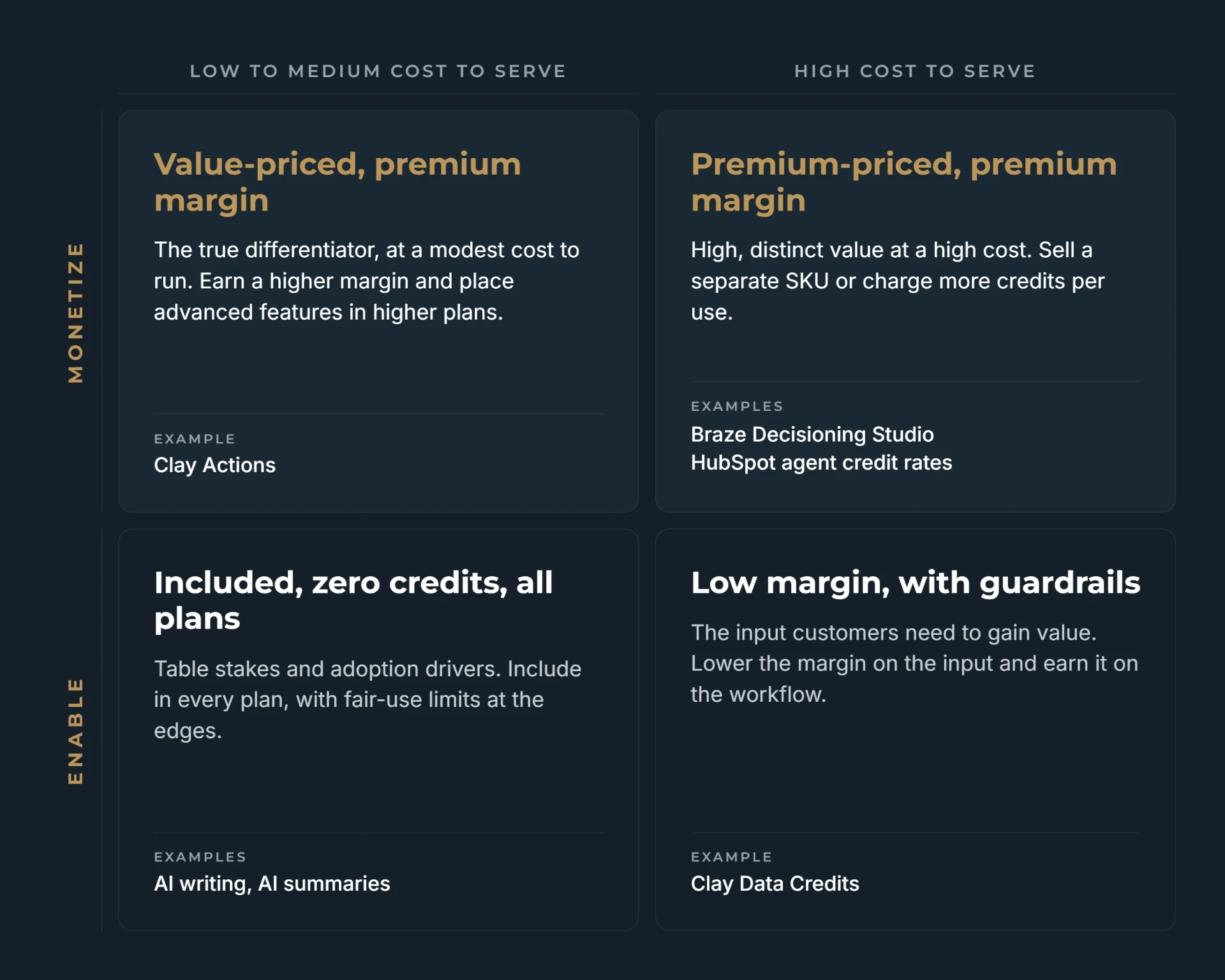
Enable + Low to Medium Cost to Serve: Included, Zero Credits, All Plans
AI writing and AI summaries are the clearest examples. Most SaaS products now include them in core plans at no credit cost. Customers expect these features, and each use costs little and varies little.
Metering these features creates more friction than it recovers. A credit charge on every rewrite teaches users to hesitate before clicking, which works against the habit the feature is meant to build. Including them in every plan keeps the experience simple and lets the product compete on the features buyers compare first.
Guardrails still apply at the edges. A fair-use limit protects against automated or abusive volume without touching typical users.
Enable + High Cost to Serve: Low Margin, With Guardrails
Some features carry real cost but still serve an adoption goal. These features are usually the input for customers to gain value.
Clay's Data Credits show this pattern. In March 2026, Clay split its single credit into two meters. Data Credits pay Clay's 150+ third-party data providers, and Actions measure Clay's own platform work. Clay states that buying data through Clay is now comparable to buying it externally, and the cost of its most-used enrichments dropped by 50 to 90 percent. Clay also cut the premium on Data Credit top-ups from 50 percent to 30 percent.
Clay's value lives in Actions: the workflows and GTM execution customers build on top of the data. Data is an input to that work, so Clay lowers the margin for data input and earns its margin on the orchestration.
Monetize + Low to Medium Cost to Serve: Value-Priced, Premium Margin
This quadrant holds the widest gap between cost-plus pricing and willingness to pay. The feature carries a modest cost to run, yet it delivers value customers recognize and will pay for. A markup on a modest cost produces a modest price, and the vendor captures a small share of the value created.
Clay's Actions illustrate the alternative. Actions measure the orchestration customers run in Clay: enriching data, running AI research, and sending data to other tools. This work is Clay's true differentiator and generates high value, so Actions carry a higher margin than Data Credits. Beyond credits, Clay also monetizes its advanced features through plan placement: the Growth plan unlocks capabilities such as HTTP APIs and CRM integrations.
For features in this quadrant, the levers are placement in higher plans, a credit rate set by value, and included allowances generous enough that typical customers rarely feel metered.
Monetize + High Cost to Serve: Premium-Priced, Premium Margin
When a feature delivers high and distinct value and carries high cost, vendors monetize it in one of two ways: sell it as a separate product SKU, or keep it inside the credit pool and charge more credits per use. Both paths let the price follow the value of the outcome while recovering the cost to serve.
Separate SKU. Braze sells Decisioning Studio as a separate add-on, apart from its core product and its Agent pricing. The two products serve different jobs. Decisioning Studio maximizes a chosen business KPI across a wide range of use cases, including cross-sell, upsell, and repurchase, whereas Braze Agents help individual marketers execute a defined campaign more efficiently. Decisioning Studio ties to business outcomes, and Agents tie to marketer productivity. Folding both into one credit pool would force a single credit rate to cover a productivity tool and a revenue optimization engine. A separate SKU lets each product reflect the value it creates and gives the sales team a distinct value conversation.
More credits per use. HubSpot keeps its AI agents inside one credit pool and sets a different rate for each feature. HubSpot Credits cost $0.010 each, yet a smart property run consumes 10 credits, a resolved Customer Agent conversation consumes 50, and a Prospecting Agent recommendation to reach out to one lead consumes 100. The rate climbs with the value of the outcome: a filled data field, a resolved support case, a lead ready for sales outreach. One pool covers all three features, and the credit rate carries the difference in value.
A separate SKU fits a feature that serves a different buyer or job from the core product. A higher credit rate drives faster adoption, since existing customers can draw on a credit pool they already have.
Features Move Across the Grid
The grid captures one moment in time. Model prices fall, so features drift from high to low cost to serve. Competitors catch up, so differentiators become table stakes and drift from monetize to enable. A feature that launches as a paid add-on can become a core-plan inclusion two years later, and an enable feature can grow into an agent with premium value.
Credits make these shifts easy to absorb. Changing a feature's credit rate takes far less work than repackaging plans, so vendors can revisit placement each pricing cycle.
Applying the Framework
- List every AI feature, both current and on the roadmap.
- Estimate cost per use across all four cost layers, including the range between light and heavy users.
- Assign a strategic goal to each feature: enable or monetize.
- Place each feature in a quadrant and set the packaging and credit rate the quadrant suggests.
- Revisit placement when model costs fall or the competitive landscape shifts.
Cost to serve informs the price. Strategic goal decides it, including whether customers see a price at all.
⚡Want a Fast AI Pricing Diagnostic?
I share pricing diagnostics in a 15 to 20 minute intro call.
📩 helenchou@helenc.cc