In The Revenue Stream Hiding in Your Internal Tools, I wrote about the tools companies build to deliver their own work: the systems that let a services team ship higher quality in less time with fewer people. This post picks up the group where that pattern is moving fastest, consulting firms and service providers.
Many of these firms sold pure services until recently. Now they are building internal tools with AI to help consultants research, analyze, draft, and deliver. The tools work. An engagement that once needed five people might now need two. And the same firms are asking a pricing question: can the tool earn revenue on its own?
How services firms have made money
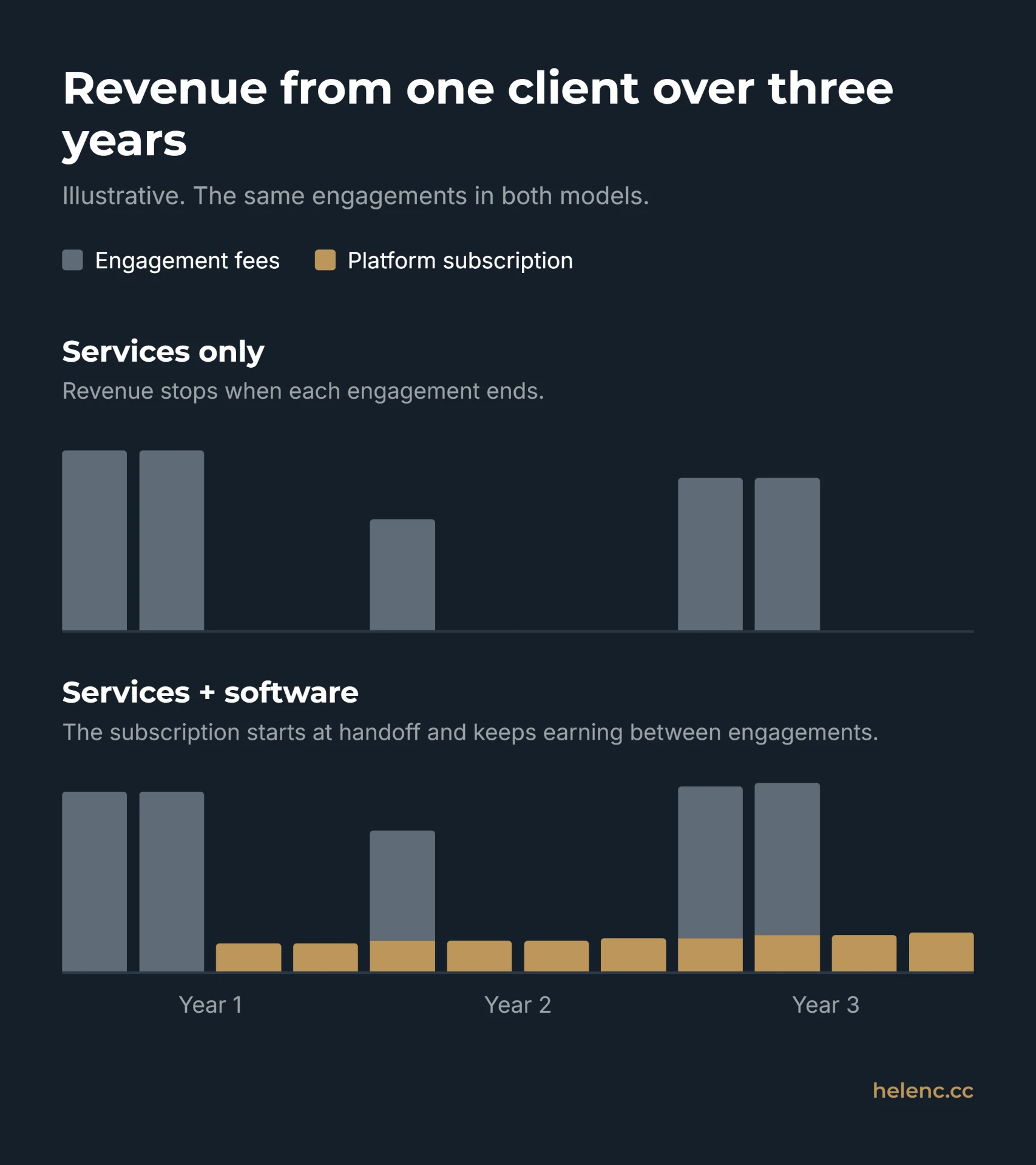
A services firm traditionally earns revenue by delivering work over a set period. A three-month strategy engagement, an annual audit, a tax season. When the engagement ends, the revenue ends, and the next dollar requires a new sale.
Every dollar of that revenue also carries a staffing cost. Costs scale with revenue: a bigger engagement needs more consultants and more analysts. Growth means hiring, and margin stays roughly flat because the people doing the work are the product.
What changes when the tool does part of the work
An internal tool that lets a smaller team deliver better work shifts this model in four ways. Cost reduction is the most visible. The other three matter more for pricing.
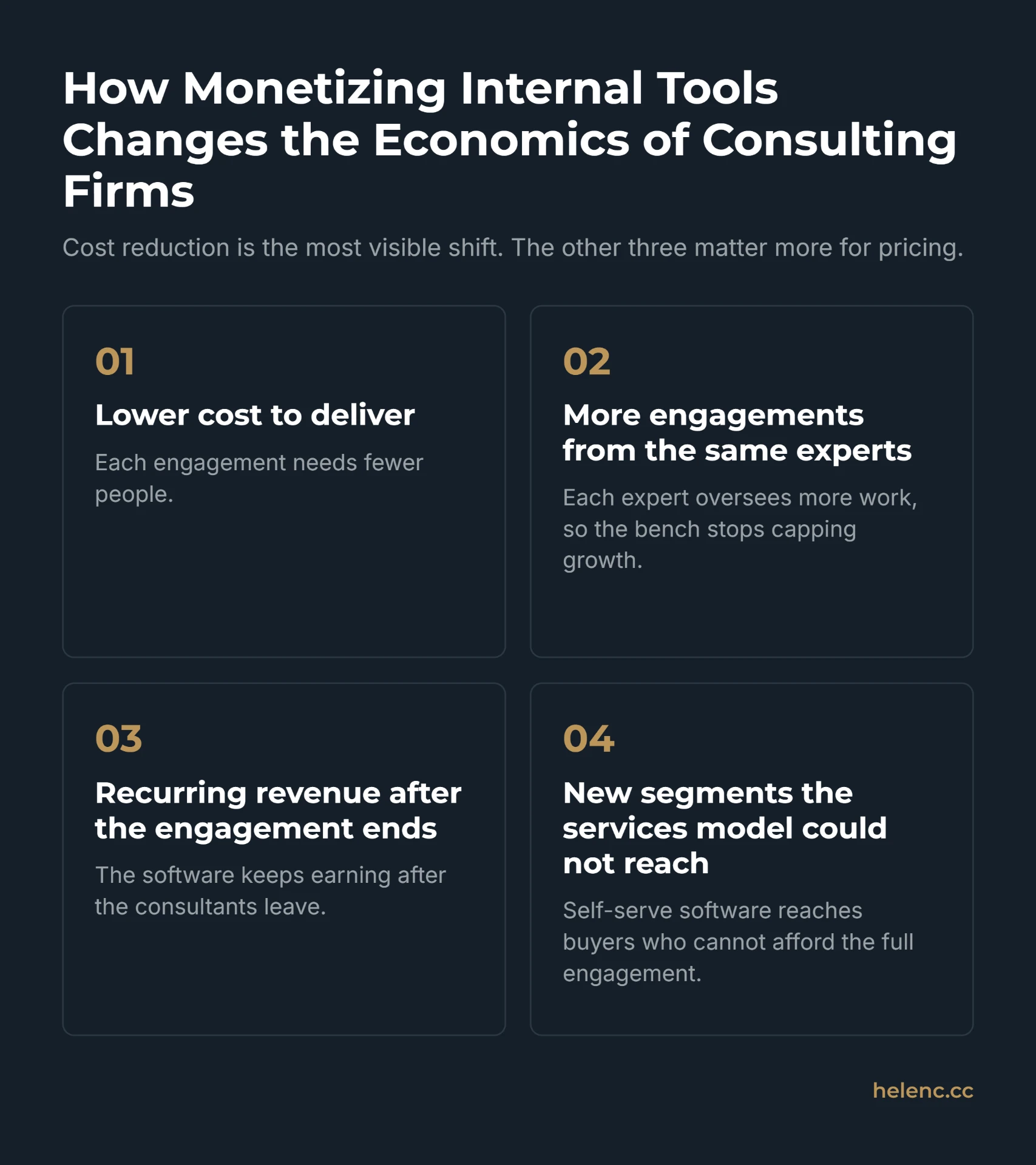
1. Lower cost to deliver
The tool reduces the number of people each engagement needs. Fewer consultant hours on the same scope is a direct cost reduction.
How much of that saving the firm keeps depends on how it prices. A firm billing by the hour passes most of the saving to the client through a smaller invoice. A firm charging a fixed fee, or pricing on the deliverable, keeps the saving as margin. For many firms, the internal tool becomes the moment to revisit time-and-materials pricing.
2. More engagements from the same experts
Senior experts are the scarce resource in most services firms. Each partner or principal can lead only so many engagements at once. When the tool handles research, first drafts, and analysis, each expert can oversee more engagements. The firm grows revenue without hiring at the same rate, and the size of the expert bench stops capping growth.
3. Recurring revenue after the engagement ends
Services revenue is mostly one-time. Software keeps working after the consultants leave. A client who worked with a tax advisory firm can keep using the firm's platform to prepare and file next year's returns. A client who hired a firm to stand up a project management office can keep running projects in the firm's tool after handoff.
That continued use is a subscription. It turns a one-time project into an ongoing relationship, and it keeps the firm close to the client between engagements.
4. New segments the services model could not reach
Most services firms have a sweet spot. Firms built to serve large enterprises rarely have an economic model for small businesses, because the deal size cannot cover a consulting team. A self-serve tool, or software paired with light services at an accessible price, lets the firm serve small businesses without deploying a team. The firm's methodology reaches buyers who could never afford the full engagement.
Pricing each shift
Each of these shifts points to a different pricing decision.
Lower cost: change the unit you charge for. Moving from hours to a fixed fee, a per-deliverable price, or an outcome lets the firm keep the efficiency gain. The value story moves from effort spent to result delivered.
More engagements: protect the price of expertise. When the tool does more of the work, clients may expect to pay less. The pricing has to point to what the expert still brings: judgment, accountability, and context specific to the client's business.
Recurring revenue: define what continues after handoff. The firm decides what the client keeps access to when the engagement closes, and what the subscription is priced on. Common choices are seats, entities managed, projects or filings, and usage. A natural structure pairs a one-time engagement fee with a platform subscription that starts at handoff. Some firms include the first year of the subscription in the engagement fee, so the client builds the habit before the first renewal.
New segments: build a ladder. The offering can span three levels: self-serve software for small businesses, software with light services for the mid-market, and the full engagement, with the software included, for enterprises. Each level has its own price point and buyer, and the ladder gives clients a path to move up as they grow.
What comes up early
A few questions surface soon after a services firm starts selling software.
Will enterprise clients trade down? A self-serve tier priced for small businesses can tempt existing clients to buy the tool instead of the engagement. Packaging that reserves expert time and accountability for the higher levels keeps each tier pointed at its intended buyer.
Who sells and supports the software? Consultants are trained, and often paid, to sell engagements. A subscription needs onboarding, support, and someone who owns the renewal.
How does the firm track the new revenue? Software revenue carries a different margin profile and a different growth story than services revenue. Reporting the two separately shows whether the software line is growing on its own or simply moving revenue out of engagements.
The pattern
The internal tool began as a way to deliver services faster. For a services firm, it can become the bridge from one-time projects to recurring revenue, and from one segment to several.