AI pricing is changing faster than any competitive deck can capture.
Competitive analysis often means studying competitors' experiments that may or may not apply to your product, your segment, or your cost structure. Meanwhile, customer expectations shift constantly as OpenAI, Gemini, Claude, and other players change their packaging and pricing.
The most reliable path to a strong pricing model is primary research: direct signal from customers.
The most reliable way is an AI pricing survey designed to reveal three things: how customers want to pay, how much they are willing to pay, and what they need to feel confident buying.
This post breaks down how I design pricing surveys for AI products, especially when the product is not fully built yet.
When Is the Right Time to Run an AI Pricing Survey?
The best time is as soon as possible.
The moment the product roadmap is set, pricing should partner closely with Product. It is completely okay if the AI feature is not ready. In fact, waiting until launch is one of the biggest mistakes pricing teams make.
You can still run a high-quality pricing survey early by doing one simple thing:
Mock up the experience.
Tools like v0 (or any equivalent prototyping tool) make it easy to create UI screens that explain the feature, the workflow, and the value. A pricing survey becomes dramatically more accurate when customers can see what they are "buying."
Who Should You Survey?
Your target audience depends on your go-to-market motion.
If you are PLG (product-led growth)
Survey:
- Admins
- Owners
- Sometimes power users, but only if they influence upgrades
These users understand the workflow, manage budgets at the team level, and feel the friction when something is paywalled.
If you are sales-led
Survey:
- Buyers (budget owners)
- Champions (internal drivers)
- Sometimes finance stakeholders in deeper research
Champions often love the AI value. Buyers often worry about predictability and cost control. You need both perspectives.
What Format Should You Use?
PLG survey formats
- In-app survey (best for speed and scale)
- Email survey (best for longer responses)
Sales-led survey formats
- In-app survey (works for broad signal)
- Email survey (targets budget owners who are not product users)
- Roundtable user research meetings (best for depth)
Roundtables are especially powerful when you partner with Product, because the conversation naturally expands into workflow, adoption, and value.
The Most Important Rule: Define the AI Feature Clearly
Before you ask customers how much they would pay, you must ensure they understand what the AI product actually is.
A strong survey starts by defining the offering.
Ask: "What exactly is this AI feature?"
- Describe the capabilities in plain language
- Quantify value, such as: time saved, cost reduction, revenue generation, risk mitigation
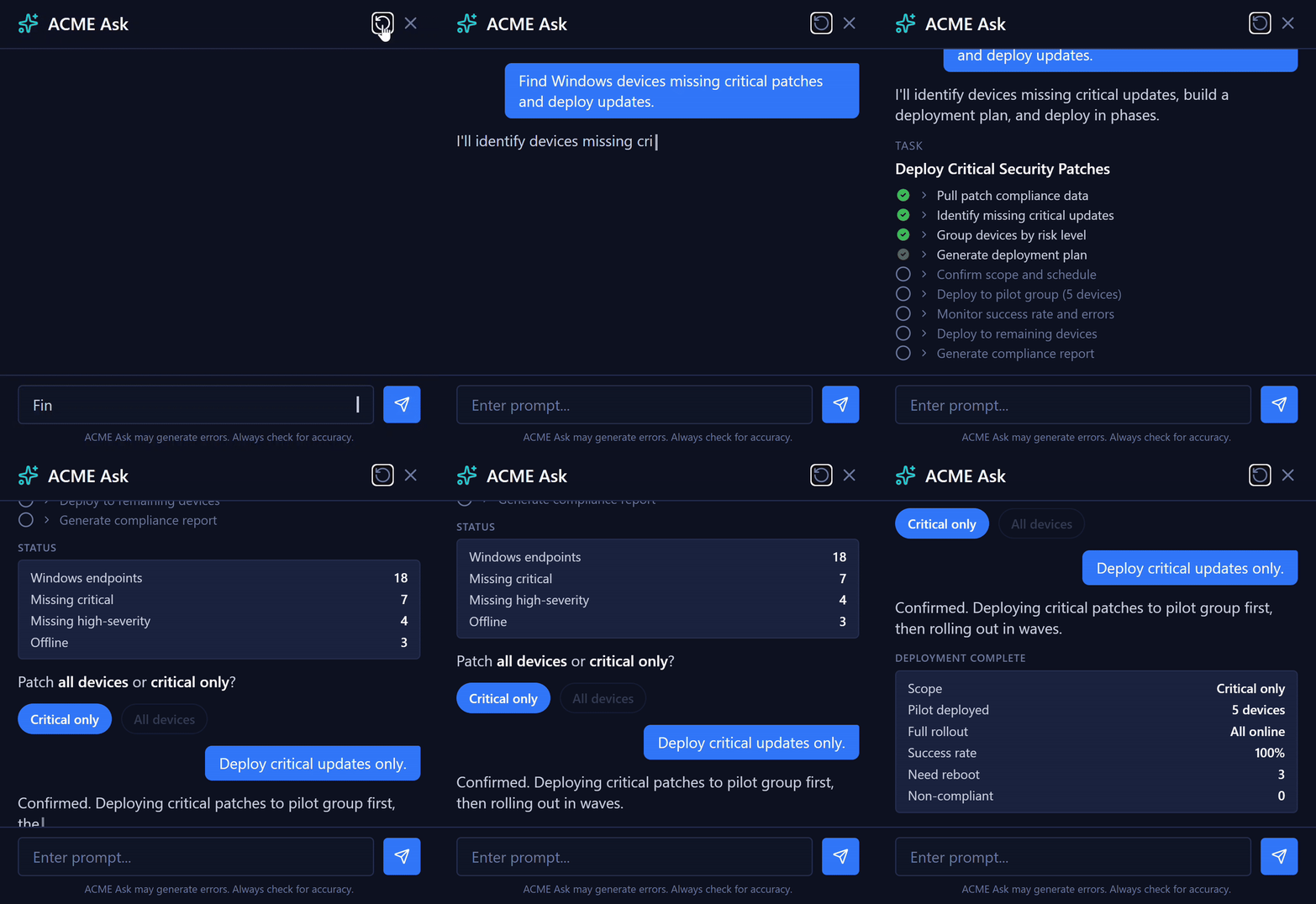
And ideally: show a UI mockup using v0.
Sample:
This AI feature automates IT security workflows end-to-end, from detection and prioritization to remediation and reporting. Patch deployment is just one example: the system can identify devices missing critical updates, deploy patches in phases, and track success automatically. For many teams, this reduces manual overhead and can save up to 20 hours per week.
The Core Survey Questions (3–4 Questions Max)
In a simple pricing survey, I recommend keeping the survey to 3–4 questions.
More questions do not mean better data. It usually means lower completion rates and noisier results.
Here is a survey structure that works well across most AI monetization problems.
1) How would you prefer to pay for this AI feature? Why?
- Pay for all users in the account
- Pay for selective users in the account
- Pay by AI Agent
- Pay by credits
- Other: ________
The "why" matters as much as the choice itself. It reveals whether customers are optimizing for: predictability, simplicity, or budget control.
Note: Questions 2 and 3 use a lightweight version of the Van Westendorp pricing framework, adapted for AI packaging decisions.
2) Based on your answer above, what price feels too expensive?
This gives you the upper bound.
3) Based on your answer above, what price feels too low?
This gives you the credibility floor.
Optional: When you should add a 4th question
If you have room for one more, add:
What would you need to see in order to feel confident buying this?
This is one of the most valuable AI pricing questions because it reveals what customers need for clarity: usage dashboards, guardrails, admin controls, predictable caps, examples, case studies, and ROI metrics.
Make it multiple choice.
Then run a follow-up survey using mockups (dashboard views, guardrails, caps) to validate what actually drives confidence.
Roundtables Are Different: Go Deeper
If you are running a roundtable user research meeting, you can go deeper into:
- Budgeting behavior
- Approval workflows
- Concerns about runaway AI costs
- Adoption barriers
- What "success" looks like internally
Roundtables also surface the language customers use to justify the spend internally, which is gold for packaging and sales enablement.
A survey gives you signal. A roundtable gives you context.
Pricing Surveys Are Not One-and-Done
Pricing surveys should not be treated as a one-time decision tool.
They are part of an iterative process.
AI pricing changes fast. Your survey process should match that speed.
The goal is not to blindly adopt survey results. The goal is to identify patterns and then run follow-up research to understand the "why."
Example: When survey results look messy, do not force a conclusion
Let's use the AI Agent example. If willingness-to-pay for agents varies wildly, it might be because users have not seen the real product. In that case, it may be smarter to launch with credit-based pricing first.
Credit pricing allows customers to experience the value and build intuition about usage. Then, after adoption begins, you can run a second survey to measure willingness-to-pay again with real product exposure.
Example: When two pricing models look too close
If willingness-to-pay for "Pay for all users" and "Pay for selective users" comes back nearly identical, that is usually a red flag. It often means the customer does not understand the tradeoff yet.
This is a great case for a follow-up survey focused only on those two options.
In the follow-up, you should not shy away from being explicit: if customers pay only for selective users, the price per user is expected to be higher, because AI costs are not averaged across the full account. Customers can handle this logic. In fact, clarity builds trust.
Final Takeaway
AI pricing moves too fast to rely on competitive analysis alone.
The fastest path to a strong pricing model is primary research.
Get direct signal from your customers on how they want to pay, how much they want to pay, and what clarity they need to buy.
Do not wait until the product is finished. Use mockups to run pricing surveys as soon as the roadmap is set.