Most B2B SaaS companies say they want to "expand into a new segment."
What they usually mean is: they want the same product and the same package to win in more deals.
And when win rates are low, the default reaction is predictable:
- discount harder
- bundle more features into the same tier
- promise Enterprise-level services for free
That is not segmentation. That is turning your pricing into a negotiation.
Most companies do not fail in new segments because their product is "too expensive." They fail because they bring the same package into every deal and assume the only lever is price.
Real segment pricing and packaging is not about lowering price.
It is about designing the right offer for how each segment buys, adopts, and expands.
The Segmentation Problem Is Bigger Than Price
Segments are not defined by willingness to pay alone.
They are defined by different needs, different constraints, and different definitions of success.
If you treat segmentation like a discount strategy, you will get exactly what you designed for:
- low win rates
- weak adoption
- constant pricing pressure
- messy retention
The goal is not to "price down." The goal is to create segment-specific offers that make sense for the customer.
Segment Pricing and Packaging Is a 3-Lens Offer Design Problem
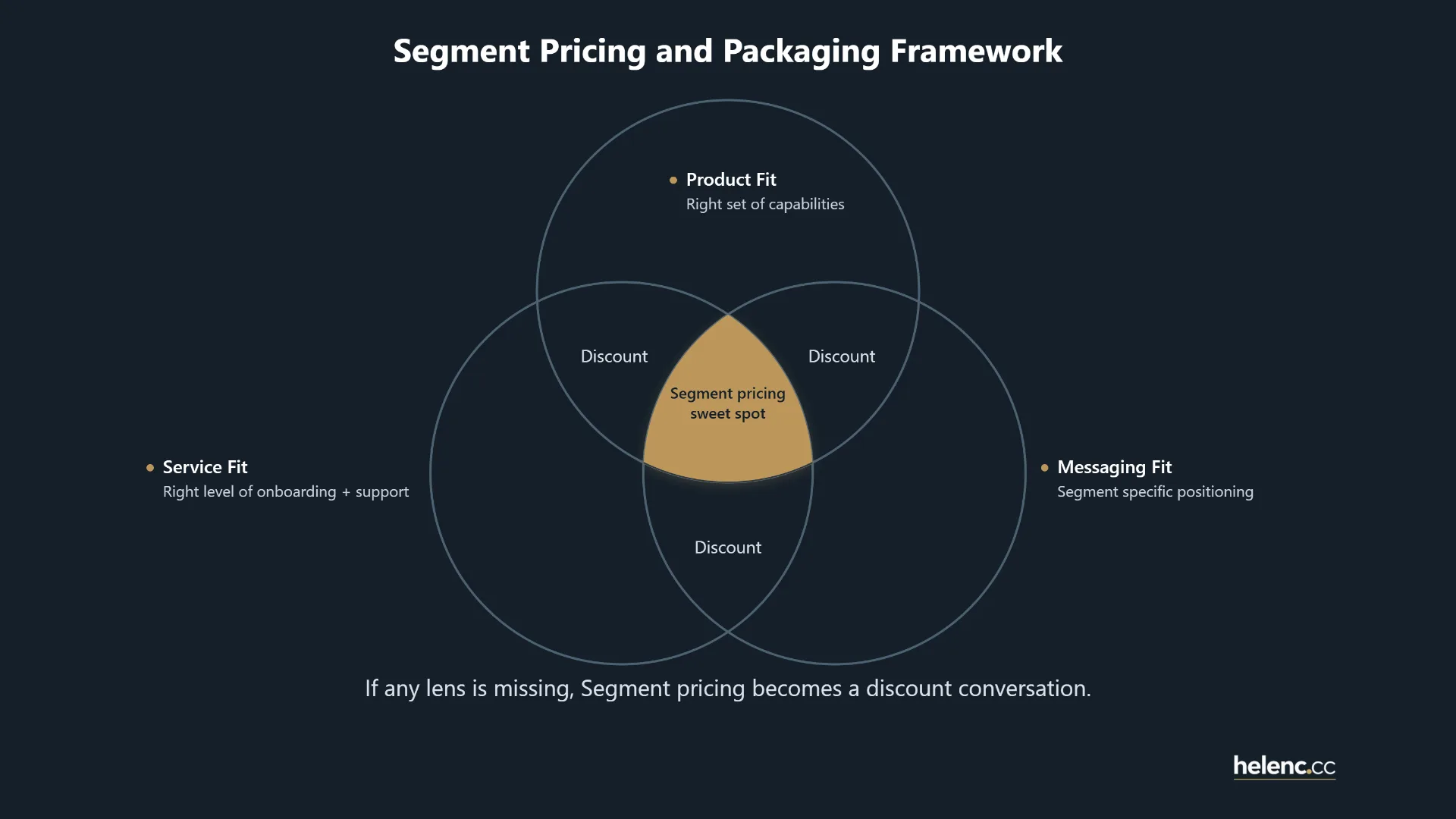
The strongest segmentation strategies are designed through three lenses:
- Product Fit
- Service Fit
- Messaging Fit
This is the difference between "Enterprise, but cheaper" and a segmented offer that actually wins.
1) Product Fit: Package the Right Value for Each Segment
The first step in segmentation is not pricing.
It is clarifying what each segment actually needs.
Customer research should separate:
- must-have capabilities
- nice-to-have capabilities
- segment-specific requirements
Enterprise customers may require the full breadth of the platform. Midmarket often wants focus, but with scalability. SMB customers often need a narrow workflow that delivers value quickly.
Example: A platform offers network automation and security virtualization globally. Enterprise may need both network automation and security virtualization. Midmarket may only need one. SMB may only need a lightweight offering in limited regions.
In that scenario, the Enterprise price point does not make sense for Midmarket or SMB. Not because those segments are "cheap," but because the value they receive is different.
Segment packaging should reflect the value customers actually use.
2) Service Fit: Match the Adoption Model to the Segment
Segments also differ in how they adopt.
Enterprise customers often require:
- custom onboarding
- deeper implementation guidance
- advanced support
- expert services
Other segments may need:
- faster onboarding
- lighter services
- clearer setup guidance
- more self-serve support
A practical way to validate this is by analyzing customer support and onboarding data:
- What types of tickets come from each segment?
- Where do customers get stuck?
- Which questions repeat most often?
This is a powerful input for designing the right offer per segment, without dragging expensive Enterprise service layers into every deal.
3) Messaging Fit: Speak to the Outcomes Each Segment Cares About
Even when the product is the same, the story should change.
Segments care about different outcomes:
- SMB may prioritize simplicity and speed
- Midmarket may prioritize time-to-value and scalability
- Enterprise may prioritize governance, security, and compliance
Segment pricing fails when the messaging is built for one segment and reused everywhere.
Strong segmentation often includes:
- segment-specific packaging names
- dedicated marketing pages and collateral
- positioning that is not "Enterprise-lite," but "built for you"
The good news is that with AI, the cost of producing segment-specific collateral is dramatically lower than it used to be.
If you want examples, I wrote about it here: How I Use AI to Accelerate Pricing Iterations.
The Takeaway
Segmentation is not a pricing problem. It is an offer design problem.
The fastest way to unlock a new segment is rarely "build more features." It is to repackage the value you already have into an offer that matches how that segment buys, adopts, and expands.
When you get segmentation right, you do not just improve win rates. You reduce discounting, improve retention, and create a cleaner path to expansion.
In many cases, it is the most cost-effective growth strategy available.
⚡Want a Fast Segmentation Diagnostic?
If you are trying to grow into a new segment (or improve performance in an existing one) without turning it into a discount strategy, I help B2B SaaS teams design segment-ready pricing and packaging.
My work focuses on:
- segment-specific offer design
- packaging and tier architecture that improves adoption and expansion
- AI monetization and PLG + sales-led pricing models
You can learn more at helenc.cc, or reach out directly if you want a fast diagnostic of your current segmentation and packaging strategy.